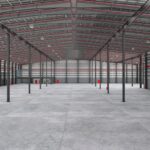

How to Choose the Right Warehouse Size for Your Business in Oragadam
Selecting the ideal warehouse size is a pivotal decision for any business expanding into Oragadam’s booming industrial corridor.
Too much space raises your lease and operating costs; too little can hamper efficiency and growth.
This guide combines industry formulas, local insights and OneAlpha’s expertise to help occupiers make an informed decision.
Why Warehouse Size Matters
The size of your warehouse influences:
- Operational efficiency and cost – A correctly sized facility reduces wasted space, improves throughput and avoids unnecessary rent.
- Inventory management – Adequate floor area and clear height ensure you can store products safely, follow first‑in‑first‑out (FIFO) processes and accommodate seasonal peaks.
- Scalability – Planning for expansion allows you to grow without costly relocations or cluttered workflows.
Factors That Determine Your Warehouse Size
Inventory volume and turnover
Selecting the ideal warehouse size is a pivotal decision for any business expanding into Oragadam’s booming industrial corridor.
Too much space raises your lease and operating costs; too little can hamper efficiency and growth.
This guide combines industry formulas, local insights and OneAlpha’s expertise to help occupiers make an informed decision.
Product dimensions and stacking height
The physical size of your goods determines how efficiently they can be stacked.
Palletized goods can usually be stacked several layers high; irregular or fragile items may need more floor area.
OSHA stacking guidelines and your racking system will influence allowable heights.
Order frequency and workflow
High‑volume e‑commerce or 3PL operations need additional space for picking, packing and staging.
Allocate room for inbound and outbound docks, forklifts, and cross‑docking if applicable.
Expansion plans
Plan for growth by analysing sales forecasts and seasonal peaks. Portal Warehousing advises selecting a facility that accommodates future expansion without overspending. It’s easier to grow into a slightly larger space than to relocate within a year.
Additional functions and amenities
Factor in non‑storage areas such as office cabins, meeting rooms, restrooms, employee break spaces and maintenance zones.
ESR India’s warehouse leasing guide notes that space should be planned for material flow, loading/unloading, staff movement, parking and power or water infrastructure.
Calculating Your Warehouse Space Requirements
Below are two commonly used methods for estimating space. Use them together to arrive at a robust figure.
1. Floor Area (Square Footage)
This method calculates the minimum square footage required based on pallet count, pallet size, stacking height and utilisation ratio. Crown LSP Group outlines the following steps:
- Add up the number of pallets you need to store.
- Divide by the stacking height – if you plan to stack two pallets high, divide by 2; if you can’t stack, divide by 1.
- Calculate the area per pallet – multiply pallet length by pallet width (e.g., a standard 48 × 40 inch pallet equals 13.33 sq ft).
- Multiply stacks by pallet area – this gives the base storage area. For example, 16 pallets stacked two high (8 stacks) × 13.33 sq ft = 106.6 sq ft.
- Divide by your target utilisation ratio – a 50 % utilisation ratio ensures safe circulation. Continuing the example: 106.6 ÷ 0.50 = 213.2 sq ft.
Add 20–30 % to account for aisles, staging and non‑storage functions. Adjust stacking height and utilisation ratio according to product fragility and turnover.
2. Cubic Capacity (Volume)
For warehouses with high clear heights, calculating volume helps gauge storage potential. ShipBob’s capacity guide recommends multiplying usable floor area by maximum stack height to get cubic feet:
Storage capacity = Usable Space (sq ft) × Maximum Stack Height (ft).
First determine usable space by subtracting non‑storage zones. For example, a 150,000 sq ft facility with 30,000 sq ft of offices leaves 120,000 sq ft usable.
If the clear height is 30 ft, storage capacity is 3.6 million cubic feet. You can then estimate how many pallets or cubic metres of goods will fit based on your product dimensions
Putting It Together
Use both methods to cross‑check your estimate. If your inventory is bulky but stackable, volume calculations may highlight the advantage of high ceilings.
If goods can’t be stacked, rely primarily on floor area. Always leave room for future growth and efficient workflows.
Typical Warehouse Sizes
Based on industry benchmarks and competitor insights, here are common categories:
- Small warehouses (50–200 m²) – Ideal for startups, seasonal inventories or small retailers. KTG Industrial notes that small units offer cost efficiency, ease of management and quick setup.
- Medium warehouses (500–5,000 m²) – Suit growing SMEs and distributors requiring racking systems, office space and dedicated loading docks.
- Large warehouses (1,000–10,000 m² and above) – Designed for manufacturers, logistics hubs or e‑commerce fulfilment centres. These facilities often feature high clear heights (9–15 m), multiple dock doors and automation compatibility.
Local Considerations in Oragadam
Based on industry benchmarks and competitor insights, here are common categories:
- Strategic location and connectivity – Oragadam sits on the Chennai–Bengaluru highway and is close to the Chennai port and airport. Livify Properties highlights that this connectivity makes it a preferred logistics hub.
- Proximity to manufacturing clusters – The area hosts automotive, electronics and heavy machinery factories. Locating your warehouse near suppliers or customers reduces transport time and costs.
- Infrastructure and technology – Modern warehouses in Oragadam offer automated storage systems, cold storage facilities and robust security. Ensure your chosen space supports your technology needs and offers reliable power and water.
- Labour availability – Oragadam benefits from a skilled industrial workforce. Adequate space for safe employee circulation and amenities is essential.
- Cost and sustainability – Land and rental rates in Oragadam are more affordable than in central Chennai. Eco‑friendly features like solar panels and rainwater harvesting can reduce operating costs and align with ESG goals.
Lease vs. Build‑to‑Suit vs. Flexible Spaces
Leasing offers flexibility. Portal Warehousing points out that renting allows businesses to scale without heavy upfront investment and often includes amenities like security, maintenance and management. This is ideal if your space requirements may change or if you’re testing the Oragadam market.
Build‑to‑suit facilities provide a fully customised layout and capacity for your operations. They require longer commitments but ensure an exact fit. Consider this option if your business has unique storage needs or expects long‑term growth.
Flexible spaces or co‑warehousing allow you to rent only the area you need within a larger facility. This model suits SMEs that fluctuate in capacity requirements.
How OneAlpha Ventures Addresses Your Space Needs
OneAlpha Ventures operates Oragadam Industrial & Logistics Park, a 53‑acre Grade‑A development that offers:
- Modular units and build‑to‑suit options – From small plug‑and‑play units to large customised facilities, the park accommodates businesses of all sizes. Clear heights up to 12 m and heavy‑duty flooring support high‑stacking and heavy machinery.
- Rapid approvals and scalability – Pre‑approved infrastructure accelerates your move‑in timeline and allows seamless expansion.
- 24/7 security and amenities – Wide internal roads, multiple dock doors, driver amenities, worker housing and integrated power ensure smooth operations.
- Sustainable design – The park is IGBC Platinum certified and incorporates renewable energy, low‑carbon materials and circular waste management.
By leasing or building within OneAlpha’s park, you gain a strategic location in Oragadam, flexibility in sizing and access to a ready workforce and modern infrastructure.
Conclusion
Choosing the right warehouse size in Oragadam involves more than picking a number. Assess your inventory volume, product characteristics, workflow and growth plans; apply proven formulas to estimate floor and cubic capacity; and consider local factors like connectivity, cost and sustainability. Once you have a baseline, evaluate leasing versus build‑to‑suit options to find the best fit.
OneAlpha Ventures combines customised space, modern amenities and eco‑friendly design to support your expansion into Oragadam. Whether you need a small flexible unit or a large high‑bay facility, the park’s scalable options ensure your warehouse size grows with your business. Reach out to explore how you can optimise storage, control costs and secure a foothold in one of Chennai’s most dynamic industrial hubs.
FAQs
1. How do I calculate the right warehouse size for my business?
To calculate the right warehouse size:
- Estimate the total number of pallets or units you need to store.
- Divide by stacking height (if pallets can be stacked).
- Multiply pallet length × width to calculate square footage.
- Adjust for a warehouse utilisation ratio (typically 50–70%).
- Add 20–30% extra space for aisles, staging, offices and operations.
You can also calculate storage capacity using:
Storage Capacity = Usable Floor Area × Clear Height
This helps determine cubic volume in high-bay warehouses.
2. What warehouse size is ideal for a growing business in Oragadam?
The ideal warehouse size depends on your inventory and growth plans:
- 50–200 m²: Suitable for startups or seasonal inventory
- 500–5,000 m²: Ideal for SMEs and distributors
- 10,000+ m²: Suitable for manufacturers, 3PLs and e-commerce fulfilment hubs
Businesses expanding into Oragadam should also factor in scalability, proximity to highways, and access to skilled labour.
3. What utilisation ratio should I use when calculating warehouse space?
A safe warehouse space utilisation ratio typically ranges between:
- 40–50% for fragile, irregular or high-turnover goods
- 60–70% for palletised, structured inventory
- Up to 80% for low-SKU, low-turnover goods
Avoid 100% utilisation, as it restricts staff movement, increases safety risks and reduces operational efficiency.
4. Is it better to lease or build a warehouse in Oragadam?
Leasing is better if:
- Your space requirements may change
- You want lower upfront investment
- You need faster occupancy
Build-to-suit is ideal if:
- You require custom specifications
- You have long-term expansion plans
- You need specialised infrastructure
Industrial parks like those developed by OneAlpha Ventures offer both modular leasing and build-to-suit options, allowing flexibility based on business needs.
5. Why is Oragadam a strategic location for warehouse expansion?
Oragadam is one of Chennai’s largest industrial corridors due to:
- Direct access to Chennai–Bengaluru Highway
- Proximity to Chennai Port and industrial clusters
- Presence of automotive and manufacturing hubs
- Competitive land and rental costs
- Skilled industrial workforce
Modern industrial parks in Oragadam provide Grade-A infrastructure, high clear heights, heavy-duty flooring and scalable layouts suitable for logistics and manufacturing businesses.