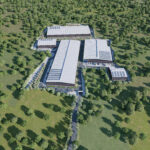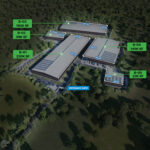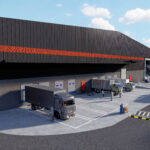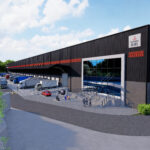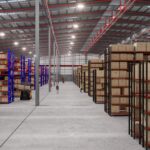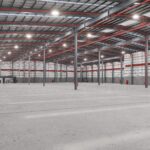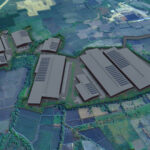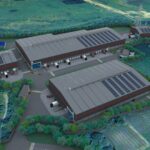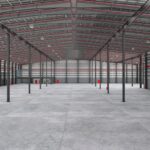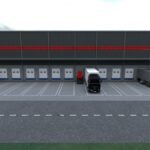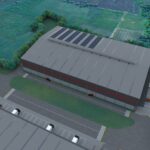

A built-to-suit warehouse is a facility a developer designs and builds to one tenant’s exact specifications, including floor loading, clear height, dock count, power, and layout, then hands over on a long-term lease. It suits businesses whose operations need something a standard warehouse cannot provide and who plan to stay for years. It does not suit businesses that need space within weeks, have ordinary requirements, or want the freedom to relocate soon.
What is a built-to-suit warehouse?
A built-to-suit warehouse, often shortened to BTS, is a facility constructed for a single tenant based entirely on that tenant’s operational requirements. The developer takes on the land, approvals, design, and construction, and the business commits to occupy the finished building on a long lease. Nothing about the structure is speculative, because every specification traces back to how the tenant actually works.
This is the opposite of leasing an existing warehouse. In a standard lease, the building already exists and the business adapts its operation to fit it. In a built-to-suit arrangement, the operation is defined first and the building is engineered around it, which is why BTS is favoured by companies with requirements that off-the-shelf space cannot satisfy.
The model is common across automotive, FMCG, pharma, and large-scale e-commerce, where facility design has a direct effect on cost and output. For these businesses, a warehouse is not just storage. It is a working part of the supply chain, and a building shaped to the operation performs measurably better than one the operation was forced into.
What does your operation actually need?
The BTS decision starts with an honest audit of your requirements, because the value of a custom build depends entirely on how specialised your operation is.
- Floor strength: Heavy machinery and dense racking demand load capacities that speculative buildings rarely guarantee.
- Clear height: Vertical storage and automated retrieval need ceiling heights standard sheds do not offer.
- Dock design: The number and placement of loading docks decides whether trucks move or queue.
- Special conditions: Cold chain, cleanroom, and hazardous handling must be built in, not retrofitted.
- Room to grow: A planned automation line or second shift needs a building designed to absorb it.
If two or more of these are non-negotiable for your operation, a standard warehouse will work against you daily, and that is the clearest sign built-to-suit deserves a look.
How does the built-to-suit process work?
Built-to-suit is often called slow and complicated, but in practice it runs as a defined sequence. Knowing where the time actually goes reveals which developers can commit to firm dates and which cannot.
Five project stages
The project moves through five stages, and four of them run on predictable timelines.
- Requirement brief: You define throughput, storage type, equipment, and growth plans.
- Land and approvals: The developer secures zoned land and statutory clearances.
- Design and sanction: Requirements become approved structural and safety plans.
- Construction: The facility is built to the sanctioned design.
- Handover: You take possession of a compliant, ready building.
The stage that decides everything
Only one stage swings the schedule, and it is land and approvals. On raw land, securing zoning, DTCP sanction, and Environmental Clearance takes 12 to 18 months before construction begins. On pre-approved land, that work is already done, so design to handover runs in roughly 9 to 14 months. The building is identical, yet the timeline more than halves, and the entire difference sits in the land. A developer offering built to suit industrial space Sriperumbudur on pre-cleared land can therefore commit to dates a raw-land project never safely could.
Should you choose built-to-suit or ready-to-move?
The choice resolves quickly once you answer three questions about your operation, your timeline, and your commitment.
- Are your needs specialised or standard?
- Is your timeline planned or urgent?
- Is your horizon long or uncertain?
Specialised, planned, and long answers point to built-to-suit, where a custom facility earns its cost. Standard, urgent, and short answers point to a ready to occupy industrial park Oragadam, which gives you Grade-A space in weeks with none of the build. There is no universally correct answer, only the one that matches how your business runs.
FAQs
Q. What is a built-to-suit warehouse?
A. It is a warehouse a developer designs and builds to a single tenant’s exact specifications, including floor loading, clear height, docks, power, and layout, usually on a long-term lease, rather than an existing building the tenant adapts to.
Q. Is a built-to-suit warehouse more expensive than a standard one?
A. The upfront cost can be higher because of customisation, but over a long lease it often lowers total operating cost by optimising the facility for throughput, cutting handling time, labour, and error rates, and avoiding an early forced relocation.
Q. How long does it take to build a built-to-suit warehouse in India?
A. On pre-approved land, roughly 9 to 14 months from design lock to handover. On unapproved land, add 12 to 18 months for acquisition, zoning, DTCP sanction, and Environmental Clearance, taking total time beyond two years.
Q. Which is better, built-to-suit or ready-to-move?
A. Neither is universally better. Built-to-suit suits specialised, long-term, planned operations, while ready-to-move suits standard requirements, urgent timelines, and businesses wanting flexibility. Your needs and horizon decide it.
Q. What industries use built-to-suit warehouses most?
A. Automotive and EV manufacturers, FMCG, pharma and cold-chain operators, and large-scale e-commerce fulfilment, all sectors with specialised requirements and long occupancy horizons where layout efficiency affects margins.
Q. Does the land affect a built-to-suit timeline?
A. Yes, more than any other factor. Pre-approved land removes the 12 to 18 month clearance stage, cutting total delivery time by more than half compared with building on raw land.